
Four Dimensions of Human Experience
How is it that people can describe completely different worlds while referring to the same situation? And could we better understand each other by expanding our perspective to include more dimensions of human experience?
In this short series, I’m exploring the foundational framework behind Needs Space – an online platform inspired primarily by Nonviolent Communication (NVC) and Integral Theory.
The framework consists of three complementary maps of human experience and reality: Needs Awareness, the Needs Quadrant, and Levels of Needs.
Together, these maps offer a way of understanding ourselves, our relationships, our development, and the human experience itself with greater clarity, compassion, and depth.
In this post, we explore the second map: the Needs Quadrant.
Towards a More Inclusive Perspective of Human Experience
Humans are meaning-making beings. Throughout evolution, we developed increasingly complex capacities for perceiving, interpreting, and responding to the world. As our lives gradually became less dominated by immediate survival, we also began asking deeper questions about purpose, identity, morality, and existence. We created stories, symbols, religions, philosophies, and scientific theories – all attempts to make sense of the reality we live in.
However, reality is too complex to grasp in its full extent. To navigate it, we create maps: simplified representations that help us understand ourselves, others, and the world. Every map highlights certain aspects of reality while leaving others in the background. The challenge is not that we use maps, but that we sometimes mistake the map for the territory, or over-identify with one map while neglecting what it cannot explain.
One of the most common ways we simplify reality is by viewing it through a single lens. We tend to explain human behaviour through me (inner experience), we (relationships and shared meaning), or it/its (biology, behaviour, systems, structures). Each lens offers genuine insight, yet none is sufficient on its own.
This tendency appears across political ideologies, scientific disciplines, philosophical traditions, and everyday conversations. Much disagreement arises not because people observe different realities, but because they interpret the same reality through different lenses.
I found inspiration for integrating these perspectives in Integral Theory, which suggests that a more complete understanding of human life requires multiple, sometimes paradoxical perspectives. By integrating these ideas with NVC, I began working with what I call the Needs Quadrant. It invites us to explore four complementary dimensions of human experience, offering a broader and more inclusive way of understanding ourselves, others, and the world.
What Is the Needs Quadrant?
One of the core assumptions in NVC is that all actions are attempts to meet needs. This can be extended to suggest that much of human expression and collective organisation is oriented towards the fulfilment of needs. This includes not only individual behaviour and interactions between people, but also collective meaning systems such as science, religion, morality, values, culture, governance, and legal systems.
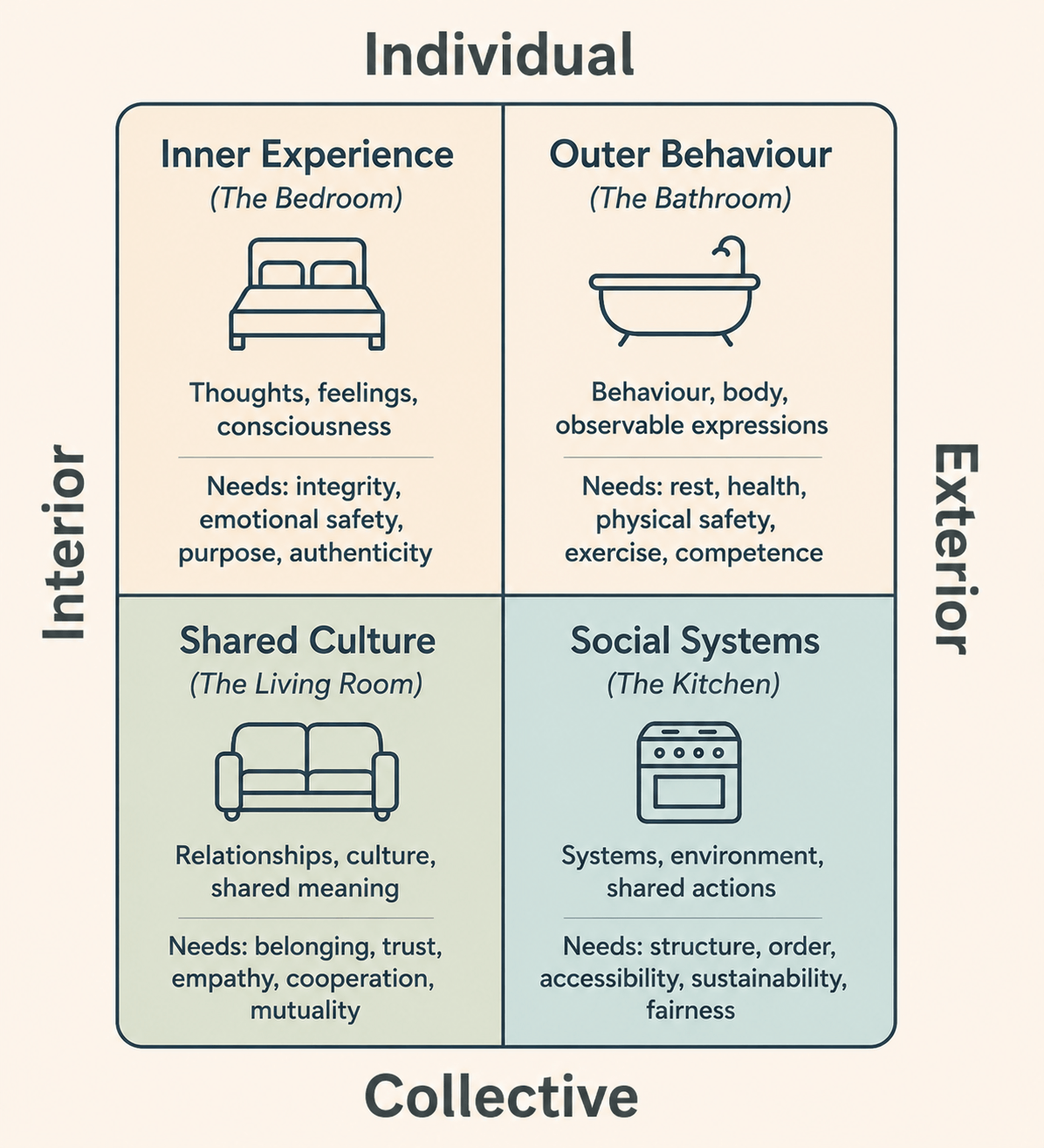
The Needs Quadrant is an attempt to include al human individual and collective expressions within a single unified model. It is a map of human experience and actions across four interconnected dimensions:
- outer expression
- inner experience
- shared meaning
- social structures
Rather than reducing experience and actions to one perspective, it invites us to hold all four simultaneously. Each dimension offers something essential, while none is complete on its own.
The Needs Quadrant
The Needs Quadrant explores four complementary dimensions of human experience: inner experience, outer behaviour, shared culture, and social systems. I use the rooms of a house as a metaphor for these dimensions, making the model easier to remember. Like the rooms in a home, each perspective serves a different purpose, and together they offer a richer understanding of ourselves, others, and the needs we all seek to fulfil.
Four Perspectives on the Same Experience
One of my favourite ways of illustrating the Needs Quadrant is to imagine becoming ill. Although illness may seem like a single event, it can be understood through four complementary perspectives, each offering insight into what is happening and how we might respond.
Let’s keep it simple and assume that being ill leaves you longing for health and well-being. Other needs may also be present – such as support, rest, or meaning – but these two are enough to illustrate the model.
Outer expression (It)
Here we focus on what can be observed and measured: body temperature, heart rate, blood pressure, inflammation, sleep patterns, and behaviour. This perspective naturally leads to strategies such as medicine, rest, and physical care.
Inner experience (Me)
Here we explore thoughts, emotions, sensations, and needs. Am I afraid, tired, frustrated, or relieved? What feels most alive in me? Only the individual has direct access to this inner world, making empathy and self-awareness essential.
Shared meaning (We)
Illness is also shaped by cultural and relational meanings. Different communities interpret illness in different ways – as an imbalance, a disease, a weakness, divine punishment, or a biological process. These meanings influence how we interpret symptoms and what we consider appropriate responses.
Social structures (Its)
Finally, there is the structural context: healthcare systems, access to treatment, work conditions, economic resources, transportation, and social security. These factors strongly influence how needs can actually be met.
Seeing the Whole Picture
None of these perspectives tells the whole story. Each highlights something essential while leaving other aspects in the background. Health is shaped simultaneously by biology, inner experience, shared meaning, and social structures.
The Needs Quadrant invites us to hold all four perspectives together – not to decide which is correct, but to understand what each contributes to a fuller picture of the situation. The same four perspectives can be applied to conflict, parenting, education, organisations, politics, and almost any aspect of human life. Once seen, they tend to become difficult to unsee.
Why This Matters
When we rely on a single dimension, we risk oversimplifying human experience.
We may say:
- “You make the wrong choices” (behavioural lens)
- “I’m too emotional” (inner lens)
- “They are dysfunctional” (cultural lens)
- “It is society’s fault” (structural lens)
Each perspective captures something real, but none is sufficient on its own.
Many of the challenges we face arise not only from conflicting values, but from incomplete ways of understanding reality. Throughout history, ideologies, movements, and traditions have often prioritised one perspective while neglecting others, sometimes leading to solutions that address part of a problem while creating unintended consequences elsewhere.
The more complex the situation, the more we need multiple perspectives. This does not mean all perspectives are equally valid in every situation, but that wise action requires awareness of more than one dimension of reality.
If we aim to create a world where people’s needs are taken into consideration, we need more than good intentions – we need the capacity to see more of what is actually happening. From this perspective, the Needs Quadrant is a practical tool for expanding awareness. It helps us include both individual and collective dimensions, inner and outer experience, so that decisions can be based on a richer understanding rather than a single explanation.
Different disciplines naturally illuminate different aspects of human life. Psychology explores inner experience, neuroscience the brain and body, behavioural science observable action, and sociology collective patterns. The Needs Quadrant does not replace these perspectives, but helps hold them as complementary rather than competing.
Needs Awareness in Four Dimensions
In the previous post, we explored Needs Awareness – the practice of recognising needs beneath action and experience.
The Needs Quadrant expands this practice by asking:
In which dimension is this need appearing right now?
A need for connection, for example, may appear as:
- a bodily sensation and/or a movement (warmth and reaching out for a touch)
- a thought and/or an emotion (“I want to reach out” and loneliness)
- a relational impulse (moving toward or away from others)
- use of structure (connecting on the internet or using a means for transportation)
The need is one – but its expression is multidimensional.
An Invitation to Explore Further
The Needs Quadrant is the second foundational map of Needs Space. It expands Needs Awareness by helping us see not only what is happening in relation to needs, but also how experience is structured across different dimensions of human life.
If these ideas resonate with you, I invite you to continue the journey with us.
Needs Space is an online community and learning platform inspired by Nonviolent Communication, Integral Theory, and a range of perspectives on human growth and development. Through practices, reflections, workshops, and conversations, we explore what it means to live with greater awareness, compassion, and clarity.
In the next blog post, we will explore the third and final map: Levels of Needs – a framework for understanding how our relationship to needs evolves throughout human development, both individually and collectively across time and cultures.
Together, these three maps offer complementary ways of seeing human experience: what is alive (Needs Awareness), how it is structured (Needs Quadrant), and how it evolves (Levels of Needs).
Until then, you might experiment with a simple inquiry:
In which dimension of experience am I meeting this moment right now?
If you are curious about Needs Space, please visit the online platform here.
Author:
Joachim Berggren
 Joachim Berggren is a certified CNVC trainer. He has been a student of NVC since 2009 and has taught his understanding of NVC since 2010. He writes blog posts, offers workshops and hosts events about NVC, as well as offering individual sessions. He is passionate about and intrigued by exploring human connection and our capacity to grow and evolve as individuals and groups throughout our lifetimes.