
How Our Relationship to Needs Evolves
How is it that we can share the same universal human needs, yet experience, express, and prioritise them in such different ways? And could exploring human development help us understand how our relationship to needs evolves throughout life?
In this short series, I’m exploring the foundational framework behind Needs Space – an online platform inspired primarily by Nonviolent Communication (NVC) and Integral Theory.
The framework consists of three complementary maps of human experience and reality: Needs Awareness, the Needs Quadrant, and Levels of Needs.
Together, these maps offer a way of understanding ourselves, our relationships, our development, and the human experience itself with greater clarity, compassion, and depth.
In this post, we’ll explore the third and last map: Levels of Needs.
We Are Continually Becoming
When I reflect on my own life, I’m struck by a paradox. Throughout my life, I have always experienced myself as the same person. There has always been an “I” looking out through my eyes and experiencing the world. And yet, in many ways, I have changed beyond recognition.
The most obvious transformation is physical. I was born weighing just over three kilograms. Today I weigh around eighty. Every cell in my body has changed countless times, yet somehow I still experience myself as the same person.
The same is true of my mind. I remember sitting in second grade, staring at a worksheet on multiplication. I simply didn’t understand what the numbers meant, so I guessed and hoped that some of my answers would be correct. About ten years later, I was comfortably working with quadratic equations, trigonometry, and calculus. The world hadn’t changed – but my capacity to understand it had.
My understanding of life has evolved in similar ways. As a five-year-old, I was convinced that the moon followed me wherever I walked. Later I realised that this was simply how perspective works. As a teenager, I was equally convinced that my fellow anarchist activists and I had understood the truth about society, while those who disagreed were ignorant, manipulated, or simply wrong. Today, I still hold strong opinions, but I have become much more aware of how easily certainty can masquerade as truth. More often than not, I find myself questioning my own conclusions before questioning other people’s.
Looking back, I don’t see a series of different people. I see one person continually developing. My body has matured. My knowledge has expanded. My worldview has evolved. And this raises an interesting question:
If we readily accept that we develop physically and intellectually, could our relationship to human needs also develop over time?
Understanding Human Development
As long as I’ve been aware that people hold different values and see the world in different ways, I’ve been curious about why. Throughout my life, I’ve explored many fields in search of an answer – economics, politics, philosophy, psychology, education, and various approaches to personal development. Each offered valuable insights into what unites us and what separates us.
When I discovered NVC, I found a powerful way of understanding human motivation. NVC showed me that beneath our enormous diversity lies something fundamental: universal human needs. While our strategies, beliefs, and behaviours may differ dramatically, they can often be understood as different attempts to meet the same underlying needs.
Over time, however, I began wondering whether something was still missing. If our needs are universal, why do people understand and relate to them so differently? Why do some people naturally prioritise security, others achievement, others belonging, and some people contribution to the well-being of all life?
My search eventually led me to Integral Theory. Rather than offering yet another explanation of human behaviour, it provided a broader framework that helped me organise many of the ideas I had already encountered into a more coherent whole. What especially appealed to me was its inclusive perspective. Instead of dismissing other models, it seeks to recognise the valuable insights each offers and understand how they complement one another.
Human development has been explored through many different lenses, and there are well over a hundred developmental models. Well-known examples include Maslow’s hierarchy of needs, Piaget’s theory of cognitive development, and Spiral Dynamics value systems. Although these models focus on different aspects of human development and use different language, many describe a similar tendency: as people develop, their perspective often expands. We become capable of holding greater complexity, integrating more viewpoints, and widening our circle of concern.
Among the many ideas within Integral Theory, one especially captured my attention: the possibility that human beings continue to develop throughout life – not only physically and intellectually, but also psychologically, morally, socially, and spiritually.
This raised a new question for me: if our capacity to think, relate, and take perspective can develop throughout life, could our relationship to universal human needs develop as well?
What Are Levels of Needs?
The Levels of Needs is a model for exploring how our relationship to universal human needs can develop throughout life. The model is not based on the idea that some needs are higher or more important than others. All fundamental human needs are equally valuable. The need for safety is not less important than the need for contribution, and the need for autonomy is not more evolved than the need for belonging.
Instead, the model explores something different: how we understand, prioritise, and seek to fulfil our needs. As we grow and develop, our needs do not disappear or get replaced by new ones. Rather, our awareness of them changes. The strategies we use to meet them change. And the number of people, beings, and systems that we include in our circle of concern may gradually expand.
The Levels of Needs can therefore be understood as a journey from narrower perspectives towards increasingly inclusive perspectives. Each level represents a different way of relating to ourselves, others, and the world around us.
At the same time, the model is not intended as a fixed hierarchy where people permanently belong to one level. Human beings are complex, and we can express different levels in different areas of life. A person may demonstrate great autonomy in one context, seek support in another, and act from a deep sense of contribution in a third.
There are also two complementary ways of viewing the model.
The first is to explore which needs tend to come more strongly into awareness at different stages of development. For example, the need for receiving support may be especially central early in life, autonomy may become more important as we develop independence, and contribution may become increasingly meaningful as our circle of concern expands.
The needs remain the same, while our relationship to them evolves.
The second is to follow a single need through all levels of development. Every universal human need exists at every level, but its expression can change. The needs remain the same, while our relationship to them evolves. For example, the need for support may be experienced as:
- receiving care from others,
- learning to ask for support while also taking responsibility for ourselves,
- creating mutual support within relationships and communities,
- supporting others and contributing to a larger whole.
In this way, the Levels of Needs is not only a model of stages we move through. It is also a way of exploring the developmental potential within every human need.
The Five Levels of Needs
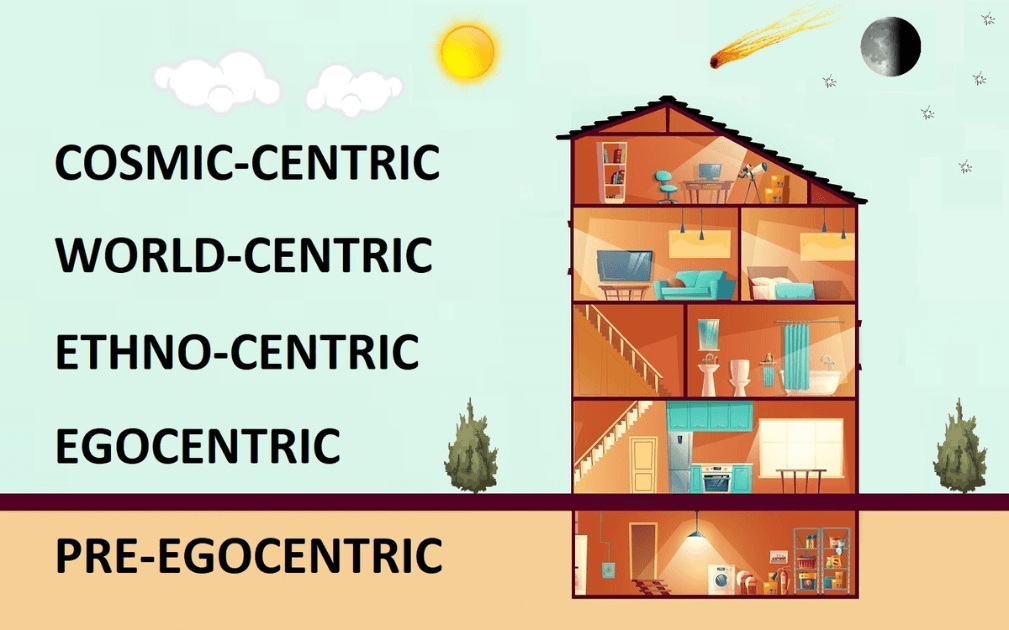
The model describes five broad levels of relating to human needs. They are not categories for judging ourselves or others, but patterns that can help us recognise different ways of experiencing and expressing our humanity.
Each level contains valuable capacities, but each perspective also has blind spots. A blind spot is not a failure or a weakness. It is simply something that may be difficult to see from within a particular perspective. Development involves becoming aware of these blind spots while integrating the gifts of each level.
Throughout the description of the five levels, we will use the need for support as a thread to illustrate this movement. Support is a universal human need, but the way we experience and express this need can transform significantly as we develop.
 Level of Needs
Level 1: Pre-egocentric – Receiving
At the pre-egocentric level, our experience is primarily one of receiving. Especially in early life, before a clear sense of self has developed, we rely on others and our surroundings to meet fundamental needs such as safety, care, and support.
Gift of this level
The gift of this level is openness to receiving. We learn that we are worthy of care and that our needs matter. This foundation of trust and connection allows later development to take place.
Blind spots
When this perspective dominates, it can be difficult to recognise our own agency and our ability to influence our circumstances. We may primarily look outside ourselves for someone or something to meet our needs.
Support at this level
Support is mainly experienced as something we receive from others:
“I need someone to take care of me.”
Level 2: Egocentric – Independence
At the egocentric level, we increasingly discover our own capacity to act, choose, and influence our lives. Autonomy, competence, achievement, and personal responsibility become more prominent. This is an important developmental movement: from depending primarily on others towards discovering our own power and ability to meet our needs.
Gift of this level
The gift of this level is agency. We learn that we can make choices, take responsibility for our own needs, develop skills, and actively shape our lives.
Blind spots
When this perspective becomes dominant, we may underestimate our interconnectedness with others. Receiving support can be experienced as weakness, and the needs or perspectives of others may become less visible.
Support at this level
Support becomes something we choose rather than something we simply receive. We become increasingly capable of meeting our own needs, yet may fail to recognise the invisible web of support that surrounds us—our relationships, communities, infrastructure, and the countless contributions of others.
“I can support myself, and I take what I want.”
Level 3: Ethnocentric – Cooperation
At the ethnocentric level, we recognise that many needs are met through relationships and shared efforts. Our attention expands from “me” towards “us”. Belonging, trust, loyalty, cooperation, and shared identity become central. We discover that independence alone is not enough. Human beings are deeply relational, and many of our needs are fulfilled through connection with others.
Gift of this level
The gift of this level is belonging. We develop the capacity to cooperate, commit, care for others, and contribute to groups and communities.
Blind spots
When this perspective becomes dominant, our care may be limited to those we identify with. People outside our group may be viewed as less important, less trustworthy, or less deserving of care.
Support at this level
Support becomes mutual and relational:
“We support each other. Together, we can meet needs that we cannot meet alone.”
Level 4: World-centric – Contribution
At the world-centric level, our circle of concern expands beyond our immediate relationships and communities. We begin to recognise the needs and perspectives of people we may never meet, including future generations, wider society, and the living world. Contribution becomes an expression of care. We are increasingly motivated not only by what we can receive, but also by what we can give.
Gift of this level
The gift of this level is a broader sense of responsibility and compassion. We develop the capacity to work for the well-being of larger systems and contribute beyond our own immediate interests.
Blind spots
When this perspective becomes dominant, we may neglect our own needs in the service of others. We may also underestimate the importance of personal relationships, traditions, or local belonging.
Support at this level
Support becomes something we offer:
“How can I use my capacity to support others and contribute to something larger than myself?”
Level 5: Cosmic-centric – Wholeness
At the cosmic-centric level, our sense of identity expands further. We experience ourselves as part of a larger whole: humanity, nature, and the web of life itself. Rather than seeing ourselves as separate individuals who sometimes care about the world, we increasingly experience connection as fundamental.
Gift of this level
The gift of this level is deep interconnectedness. Care, compassion, and contribution arise not only from responsibility but from a sense of belonging to something larger.
Blind spots
When this perspective becomes disconnected from the previous levels, there can be a tendency to overlook practical human needs or become detached from everyday realities.
Support at this level
Support becomes an expression of participation in life itself:
“Support flows through all of us; there is no clear giver or receiver.”
Bringing the Levels Together
The Levels of Needs is not a journey from “lower” to “higher” in which earlier levels are left behind. Each level represents a valuable human capacity that remains important throughout life.
We continue to need support, autonomy, belonging, and contribution. What changes is not the needs themselves, but the awareness, perspective, and intention through which we relate to them. The same need can therefore be expressed in different ways at different levels of development.
Development is not about becoming a different kind of human being. It is about expanding our capacity to recognise, embrace, and respond to the needs that are always present.
Why This Matters
Needs are universal, but our relationship to them is not static.
Two people may both long for support, belonging, or contribution, yet understand and express these needs in profoundly different ways. Recognising this developmental dimension can help us replace judgment with curiosity and disagreement with dialogue.
Rather than asking, “Who is right?”, we can begin asking different questions:
- How is this person relating to the need?
- What perspective are they seeing from?
- What might they be unable to see from that perspective?
- What gifts does this perspective bring?
Development is not about becoming a different kind of human being or becoming better than others. It is about expanding our awareness while integrating the gifts of every level.
Three Complementary Maps
This concludes the introduction to the three foundational maps of Needs Space.
Each map explores the same human reality from a different perspective:
- Needs Awareness helps us recognise what is alive beneath thoughts, emotions, and actions.
- The Needs Quadrant helps us understand where our needs are being expressed across the inner and outer, individual and collective dimensions of life.
- Levels of Needs help us explore how our relationship to those needs can evolve throughout life.
Together, they offer complementary ways of understanding ourselves, our relationships, and the world around us. One map reveals the universal nature of needs. Another reveals the many dimensions in which they appear. The third reveals how our relationship to those same needs can continue to grow.
An Invitation
If these ideas resonate with you, I invite you to continue exploring them with us.
Needs Space is an online learning community inspired by Nonviolent Communication, Integral Theory, and a range of perspectives on human growth and development. Through practices, workshops, conversations, and shared reflection, we explore how greater awareness of human needs can become a foundation for personal growth, meaningful relationships, and positive social change.
Perhaps you would like to begin with a simple question:
How is my relationship to this need expressing itself today?
Needs are universal. We experience and express them through multiple dimensions of human existence. Our relationship to them evolves throughout life.
If you are curious about Needs Space, please visit the online platform here.
Author:
Joachim Berggren
 Joachim Berggren is a certified CNVC trainer. He has been a student of NVC since 2009 and has taught his understanding of NVC since 2010. He writes blog posts, offers workshops and hosts events about NVC, as well as offering individual sessions. He is passionate about and intrigued by exploring human connection and our capacity to grow and evolve as individuals and groups throughout our lifetimes.