
When Needs Become Our Only Explanation
Would you like to explore NVC Paradoxes with me?
Register for the workshop.
When I first encountered Nonviolent Communication, I found it liberating to realise that everything people do is an attempt to meet their needs. My world transformed from one populated by idiots, selfish people, and fools into one populated by human beings who, just like me, were trying to meet their needs, sometimes through strategies very different from my own.
NVC Paradoxes is a blog series exploring recurring ideas and assumptions within NVC. Rather than rejecting these ideas, I examine what they help us understand, what blind spots may come with them, and what becomes visible when we bring other perspectives into the picture.
Over time, however, I began to question whether needs were the only explanation for human behaviour. I came to recognise not only the limitations of other explanatory models, but also what these perspectives could offer beyond NVC’s understanding.
For Those Who Don’t Want to Read the Whole Post
One of the most powerful insights of Nonviolent Communication is that all human actions are attempts to meet needs. This perspective can help us move beyond judgement and approach even difficult behaviour with greater curiosity, compassion and understanding.
But human behaviour is extraordinarily complex. Biology, psychology, culture and social systems all influence what we do. Each offers valuable explanations that we may overlook if we interpret everything exclusively through the lens of needs.
When we become convinced that needs explain every action, a perspective intended to deepen understanding can paradoxically limit our curiosity. We may even miss important aspects of another person’s reality, making empathy and connection more difficult.
We don’t need to choose between understanding needs and exploring other explanations. We can appreciate the gifts of NVC while recognising that no single perspective captures the full complexity of human behaviour.
The NVC Insight – Looking Beneath Behaviour
One central assumption of NVC is that all human actions are attempts to meet needs. This is not simply a claim about what motivates us. It also offers a fundamentally different way of relating to ourselves and others.
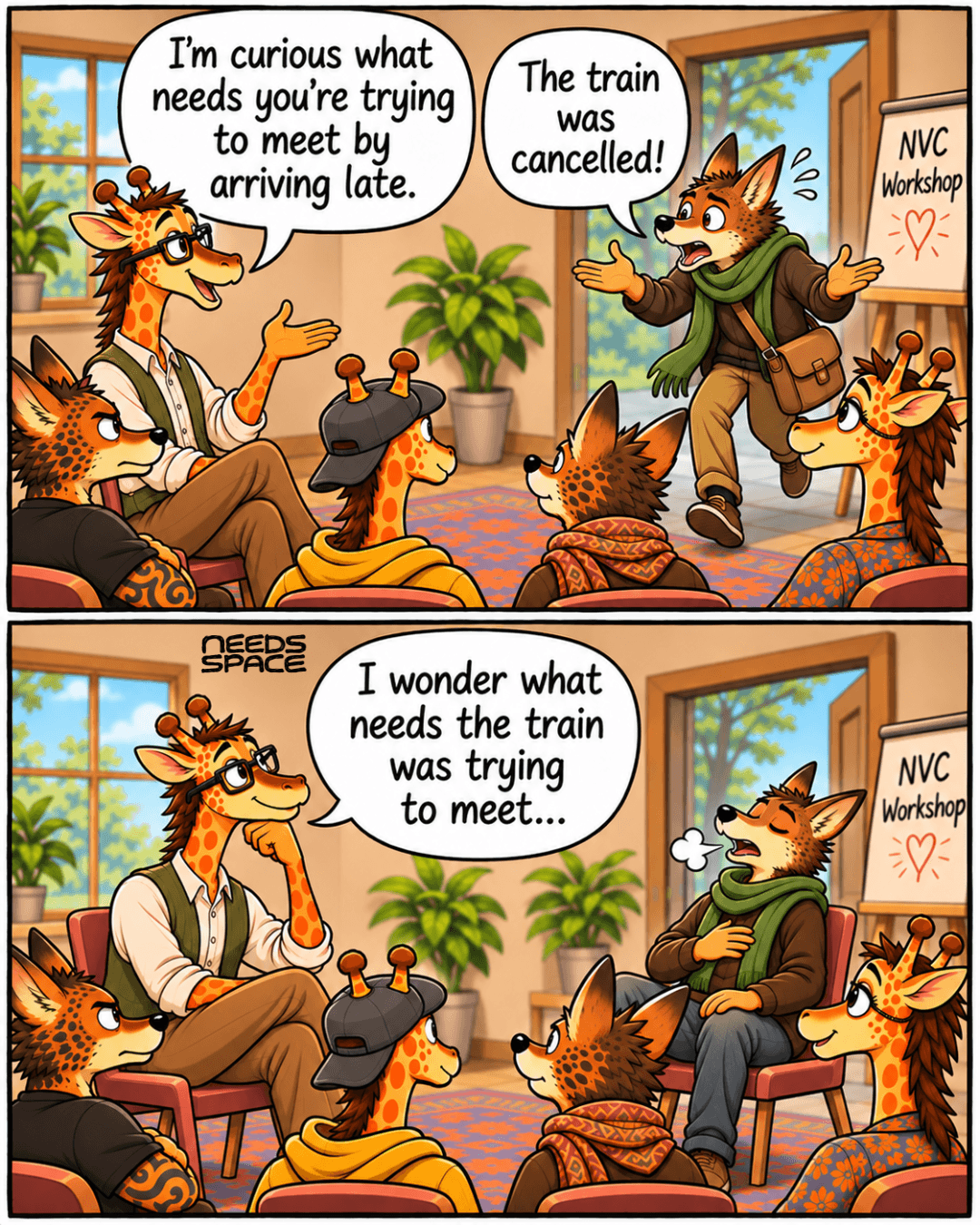 Instead of judging other people’s actions, we can become curious. We often describe people as selfish, lazy, manipulative or irresponsible. While such labels may reflect some of our own experience, they can also replace understanding and disconnect us from others. When we perceive someone as criticising us, withdrawing, becoming aggressive or refusing to cooperate, we can look beyond our interpretation of their behaviour and become curious about what matters to them.
When we focus only on people’s actions – their strategies – we may find it hard to recognise ourselves in them. Our attention can then easily turn towards how to change or fix the other person. But when we look at the needs behind their strategies, we can more readily recognise our shared humanity. We may not share the same strategies, but we share the same needs.
In NVC, needs are understood as universal human qualities or conditions that contribute to life and well-being. NVC assumes all human beings share the same needs, while strategies are the specific actions we take to meet them. Two people may share a need for safety while pursuing completely different strategies. One seeks protection through cooperation with others; another through trying to control them. Understanding this distinction can transform conflict.
The same perspective can also change how we relate to ourselves. Instead of condemning ourselves for procrastinating, avoiding conflict or reacting defensively, we can become curious about the needs our behaviour might be serving. This can open the door to greater self-understanding and self-compassion.
We no longer have to choose between condemning someone’s behaviour and accepting it. We can recognise the needs that may be motivating an action while still questioning or challenging the strategy. This is one of NVC’s most valuable contributions. And it is worth preserving, even as we examine its limitations.
The Gifts of Other Perspectives
Throughout human history, we have tried to understand why people behave as they do. Different explanations of human behaviour have helped us recognise patterns, predict actions, respond to difficulties, and create conditions that support human well-being.
Biology has revealed how profoundly our bodies and nervous systems influence our actions. When we automatically pull our hand away from a hot surface, our response is driven by a protective reflex rather than a conscious or unconscious decision. Understanding the effects of stress, hormones, sleep deprivation and neurological processes has also helped us explain behaviours that might otherwise seem irrational or inexplicable. These insights have contributed to advances in medicine, mental health care and our understanding of human functioning.
Psychology has helped us understand how learning, habits, beliefs, and past experiences shape behaviour. A person who avoids public speaking may have learned to associate it with embarrassment or rejection. Someone who repeatedly checks their phone may be responding to habits reinforced over time. By studying these patterns, psychology has developed ways to help people change behaviours, overcome fears, and develop new skills.
Culture offers another important perspective. Much of what we do is shaped by shared traditions, values and expectations that we absorb through growing up and being part of communities. How we greet strangers, express disagreement, show respect or relate to authority varies across cultures. Understanding these differences helps us make sense of behaviours that might otherwise appear strange, rude or inappropriate, and makes cooperation across cultural boundaries easier.
Social systems also shape our behaviour. Laws, institutions, economic conditions and organisational structures influence the choices available to us and the consequences of our actions. For example, when employees compete rather than cooperate, the explanation may lie partly in a workplace that rewards individual performance over collective success. Understanding these dynamics allows us to change not only individual behaviour but also the conditions that encourage it.
Each of these perspectives has expanded our understanding of human behaviour and contributed to practical improvements in people’s lives. They help us recognise that our actions are influenced by internal processes, experiences that have shaped us, the cultures we participate in, and the systems we live within. Together, they remind us that human behaviour is complex, and that different perspectives can reveal different aspects of why we do what we do.
The Blind Spots NVC Responded To
The different perspectives we have explored have greatly expanded our understanding of human behaviour. Yet even valuable explanations can leave something important out. When we focus on biological processes, learned patterns, cultural influences or social structures, we may gain valuable insights into why people behave as they do without necessarily understanding what their experiences mean to them.
Consider someone who repeatedly avoids difficult conversations. We might explain their behaviour through a stress response, experiences of earlier conflicts, cultural expectations or the power dynamics of their relationships. Each explanation may offer valuable insights. But we might still overlook something important: What is this person longing for? What matters to them in this situation? What are they hoping to protect or experience?
There is also a difference between understanding behaviour and how we respond to it. We may know that someone’s aggression is influenced by stress, upbringing or social circumstances and still see them primarily as a problem to be managed, corrected or controlled.
NVC offers another possibility. By looking for the needs behind an action, we are invited to recognise something fundamentally human, even in behaviour we strongly dislike. Instead of seeing only aggression and labelling someone as hostile or antisocial, we might become curious about a longing for protection, respect or autonomy. Instead of seeing only avoidance, whether labelled as cowardice or understood through a diagnosis of social anxiety disorder, we might become curious about a longing for safety, acceptance or peace.
This shift can transform how we relate to others. It may soften blame, encourage empathy and make it easier to find common ground without requiring us to agree with someone’s actions. Importantly, this does not mean other approaches cannot recognise people’s inner experiences or motivations. Many psychological, philosophical and therapeutic traditions do exactly that. NVC’s distinctive contribution is to place universal human needs at the centre of how we seek understanding and connection. This perspective matters not only for what it can explain, but also for the quality of attention it invites us to bring to ourselves and others.
When the Solution Becomes a Problem
Seeing human actions as attempts to meet needs can open the door to greater compassion, curiosity and understanding. But what happens when this perspective becomes more than an invitation to explore? What happens when we treat it as an unquestionable truth about all human behaviour?
A familiar saying goes: “If all you have is a hammer, everything looks like a nail.” The needs perspective is a powerful tool, but when it becomes our only tool, we risk interpreting every human action through it, even when another perspective might offer a more useful explanation.
Consider the simple example of pulling our hand away from a hot surface. We could interpret this as an attempt to meet a need for safety or protection. But from a biological perspective, the action is explained by a reflex – an automatic response of the nervous system that does not require a conscious or unconscious decision.
Of course, protecting ourselves from harm relates to important human needs. But does describing the reflex as an attempt to meet a need actually help us understand what caused the action? Or are we simply translating a biological explanation into the language of NVC?
The philosopher Karl Popper raised a related concern about certain psychoanalytic theories. He observed that even opposite behaviours could be interpreted as confirmations of the same underlying psychological theory. His concern was not simply that these explanations might be mistaken, but that the theories could be applied so broadly that almost any behaviour appeared to confirm them.
Could something similar happen when we assume that all human actions are attempts to meet needs? Might we become so accustomed to interpreting behaviour through this lens that we overlook what other perspectives could help us understand?
This can also affect how we relate to others. When we become convinced that needs must lie behind every action, we may start interpreting other people’s experiences through our own framework rather than listening to how they understand themselves. Someone might describe their behaviour as a habit, a moral commitment, a cultural tradition or simply something they did without thinking. If we insist on finding the underlying need, our curiosity can become another way of imposing an explanation.
And this is where the paradox becomes particularly interesting. A perspective intended to help us move beyond fixed judgements can itself become a fixed interpretation. What began as an invitation to understand more deeply may become a reason to stop exploring.
We do not have to abandon the needs perspective to recognise this danger. We can keep asking what needs might be involved while remaining open to the possibility that other explanations may be equally valuable, more relevant, or better suited to the situation.
An Integral NVC Perspective – Widening the Lens
Integral Theory offers a way to expand our understanding without abandoning NVC’s valuable insights. Rather than seeking a single explanation for human behaviour, we can explore different dimensions of the same situation. One central framework in Integral Theory is the Four Quadrants, which distinguish between individual and collective, and interior and exterior dimensions of reality.
Consider an employee who repeatedly arrives late for work. From an NVC perspective, we might become curious about the needs behind their behaviour. Perhaps they are trying to meet needs for rest, autonomy, family connection or balance. Exploring these possibilities could help us move beyond judgements of laziness or irresponsibility and create greater understanding. But what else might we discover if we widen our lens?
I – Individual Interior: The employee may experience stress, guilt or conflicting priorities. Their beliefs, intentions and personal experiences may influence how they approach their responsibilities. Exploring their needs is particularly valuable here, but it is not the only way to understand their inner world.
It – Individual Exterior: Sleep deprivation, circadian rhythms, health conditions, or time-management difficulties may affect their ability to arrive on time. These biological and behavioural factors may require a different kind of understanding.
We – Collective Interior: The workplace may have particular expectations about punctuality, responsibility and flexibility. Cultural differences or unspoken assumptions about what makes a good employee may shape how everyone involved experiences and interprets the situation.
Its – Collective Exterior: Work schedules, public transport, childcare arrangements and organisational policies may create practical obstacles. Some of these conditions cannot be changed simply by increasing awareness of needs.
Each perspective reveals something that the others might miss.
Imagine a manager who approaches the employee with genuine curiosity about their needs, and keeps searching for the needs behind their lateness rather than exploring the practical circumstances. Meanwhile, the employee is struggling with an unreliable train service and childcare arrangements that make punctuality extremely difficult.
The manager may have the best of intentions. Yet by continuing to search for underlying needs, they might overlook the practical reality the employee is trying to communicate.
A perspective intended to create empathy and connection can actually get in the way of both when it prevents us from recognising another person’s reality.
Empathy is not only about recognising universal human needs. It also involves being willing to understand the particular circumstances, experiences and conditions that shape another person’s life.
The needs perspective can help us recognise our shared humanity. The other perspectives can help us understand the differences in our lived realities. Together, they offer a richer foundation for understanding, connection and meaningful change.
The Unfinished Edge – What Are We Really Claiming?
A fundamental question remains: What exactly do we mean when we say all human actions are attempts to meet needs? Are we making a claim about what causes human behaviour? Are we suggesting that every action serves some function related to human well-being? Or are we offering a way of interpreting behaviour that encourages empathy and understanding? These are not necessarily the same thing.
Even within biology, our understanding of cause and effect is often limited by the extraordinary complexity of interacting processes. When we try to understand human behaviour, the challenge is even greater. Biological processes, psychological patterns, personal experiences, cultural influences, and social systems interact continuously, often in ways we don’t understand.
Against this background, claiming to have found the ultimate explanation for all human actions seems rather ambitious. However, the value of the needs perspective does not depend on such a claim. We can approach people’s behaviour with curiosity about their needs without assuming that we fully understand what caused their actions. The question, then, is not whether we should abandon the needs perspective, but whether we can appreciate its gifts while remaining humble about how much we actually understand.
Reflection and Exploration
– Can you recall a situation where looking for the needs behind someone’s behaviour helped you understand them more deeply?
– Have you ever focused on needs and missed other important parts of someone’s reality?
– What might change in your NVC practice if you approached needs as one valuable perspective among several, rather than as the ultimate explanation for human behaviour?
From Actions to Empathy
Exploring the needs behind people’s actions can help us move beyond judgement and towards greater understanding. But as we have seen, even our attempts to understand others can sometimes get in the way of genuine connection. This brings us to the next NVC paradox: Empathy Creates Connection.
Can empathy sometimes create distance rather than closeness? What happens when our efforts to offer empathy aren’t what the other person actually needs?
For more background on the ideas and intentions behind this series, please read the two introductory posts:
When Solutions Become Problems
Explore NVC Paradoxes in a Workshop
Would you like to explore these ideas together with others?
In the NVC Paradoxes workshop series, we take a closer look at familiar ideas within NVC—what they help us see, what blind spots may come with them and what becomes possible when we widen the lens. The workshops combine reflection, discussion and experiential practice.
You can register for an individual workshop for €30, or join the Needs Space platform, where all NVC Paradoxes workshops are included in your membership.
Read more about the upcoming workshops here.
Read more about joining Needs Space here.
Author:
Joachim Berggren
 Joachim Berggren is a certified CNVC trainer. He has been a student of NVC since 2009 and has taught his understanding of NVC since 2010. He writes blog posts, offers workshops and hosts events about NVC, as well as offering individual sessions. He is passionate about and intrigued by exploring human connection and our capacity to grow and evolve as individuals and groups throughout our lifetimes.