
The Gifts and Limitations Beyond Right and Wrong Thinking
Would you like to explore NVC Paradoxes with me?
Register for the introductory webinar.
I have lost count of how many times I have encountered the statement There is no right or wrong in NVC contexts. Workshops are devoted to it, trainers proclaim it, and the wider NVC community is thoroughly marinated in this belief.
NVC Paradoxes is a blog series exploring recurring ideas and assumptions within NVC. Rather than rejecting these ideas, I examine what they help us understand, what blind spots may come with them, and what becomes visible when we bring other perspectives into the picture.
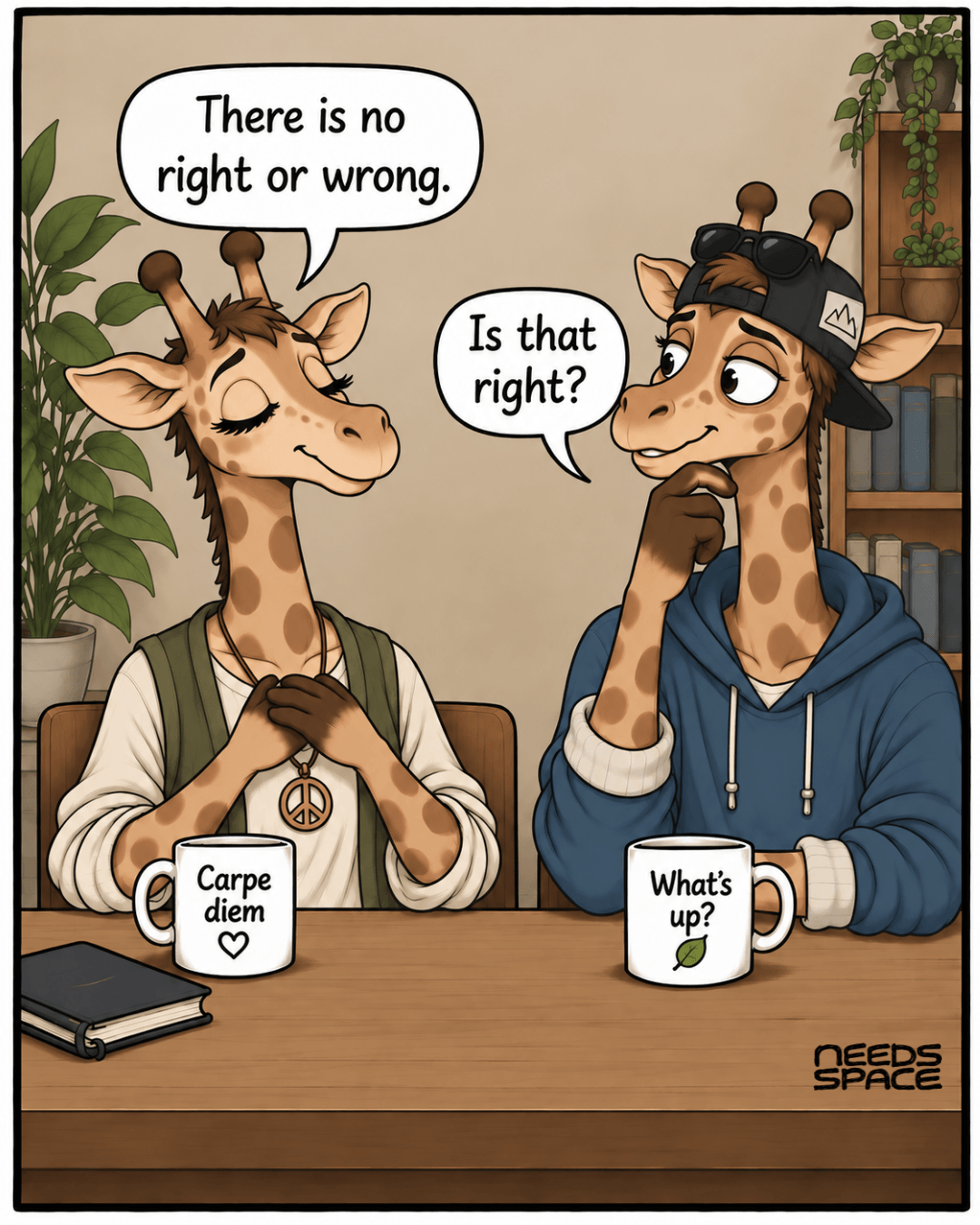
It is also one of the clearest examples of a performative contradiction: a statement whose content conflicts with the act of stating it. When There is no right or wrong is presented as a true – or more accurate – way of understanding reality, we need only to ask: Is that right? We cannot answer without using the distinction the statement tries to remove.
In this post, I want to examine the idea from several perspectives. What does it help us see? What does it leave out? When can moving beyond right and wrong support understanding and connection – and when might it make it harder to navigate responsibility, boundaries and life together?
For Those Who Don’t Want to Read the Whole Post
Moving beyond right and wrong is one of NVC’s most valuable contributions. It can free us from blame, soften conflict and help us understand the needs behind actions we strongly oppose. But right-and-wrong thinking was not simply a human mistake. It helped create shared rules, responsibility and social order, allowing large groups of strangers to cooperate and limiting the power of the strongest.
Over time, these moral systems also developed serious blind spots. Rules and demands for obedience could remain even when they no longer served their original purpose, while shame, punishment and labels kept people in line. NVC offered a new perspective. In seeing the harm of the old paradigm, however, it could sometimes overlook its gifts.
Perhaps we do not have to choose between moral judgment and moral neutrality. We may be able to combine understanding with the evaluation of actions, compassion with accountability and human dignity with clear boundaries. There is no right or wrong can be a powerful perspective without being the whole landscape.
The NVC Insight
Although the concept that There is no right or wrong is common in NVC circles, it is a simplified expression of a more nuanced idea. NVC does not ask us to abandon our values or regard every action as equally life-serving. Marshall Rosenberg distinguished between value judgments, which express qualities we cherish, and moralistic judgments, which turn those values into labels about people. When I describe someone as dishonest, selfish or bad, NVC invites me to look beneath that judgment. Perhaps honesty matters deeply to me, or the person’s actions have affected my trust.
 NVC also proposes that every action is an attempt to meet human needs. This shifts our attention from asking what is wrong with someone to becoming curious about what they are trying to protect, pursue or restore. In a personal conflict, setting aside the question of who is right can make room for experiences that neither person has been able to hear. Defensiveness may soften, and new possibilities can emerge where previously we saw only competing positions.
This shift also offers an alternative to cultures of blame and punishment. Instead of asking who deserves to suffer for what happened, we can ask what happened, which needs were affected, what responsibility each person carries and what might support protection or repair. Understanding the needs behind an action does not mean approving of the action or accepting its consequences. The enduring NVC insight is that we can seek understanding without abandoning our values – and respond to harm without losing sight of our shared humanity.
The Gifts of Right-and-Wrong Thinking
Human communities have always needed ways to distinguish between behaviour that supports collective life and behaviour that threatens it. Ideas of right and wrong helped groups establish shared expectations, protect their members and make cooperation more predictable. As societies grew larger and more complex, these frameworks allowed strangers to coordinate their actions and hold one another accountable to something larger than their immediate desires. They gave people language for responsibility, duty and fairness, and made it possible to condemn violence, deception and exploitation even when the people involved had no personal relationship with one another. Moral rules also preserved knowledge across generations: each child did not have to discover entirely through experience that some actions could cause serious harm.
Right-and-wrong thinking was not simply a mistake on the way to our current understanding. It was a major human achievement that helped challenge the principle that might makes right – that those with the greatest physical strength, wealth or power should be free to impose their will on everyone else. These standards were often incomplete and unfairly applied. Yet they allowed people to question power by referring to laws, duties and principles meant to apply to everyone.
We can see the value of this development in places where shared institutions have weakened, and different armed groups compete for power. Peaceful societies did not simply appear. They were built through long and often violent struggles over who should rule, which rules should apply and how power should be limited. Our present systems are far from perfect, but the division of power among lawmakers, governments and courts is an important attempt to replace the rule of force with shared, public rules. These institutions depend on distinctions between what is allowed and forbidden, fair and unfair, legal and illegal – and on consequences when people cross those boundaries. Without this development, many of us might still live in societies where the strongest person or group decides what is right.
The Blind Spots NVC Responded To
Moral frameworks of right and wrong helped create greater order, stability, and predictability. But long after societies had built institutions around shared laws and responsibilities, some of the strategies used to establish that order remained firmly in place. These rules were often strict from the beginning; strictness and obedience were part of how order was established. The problem was that the same rules and demands for obedience could remain long after much of the purpose they had originally served had been fulfilled.
In families, schools, workplaces and societies, authority often carried more weight than dialogue and voluntary cooperation. People who did not comply could be labelled lazy, selfish, disobedient, difficult or bad. Once someone had been identified as wrong, shame, exclusion or punishment could appear justified, while the needs, circumstances and relationships surrounding the behaviour received less attention. A system created partly to restrain harmful behaviour could itself become a source of harm.
NVC recognised this blind spot. It challenged the assumption that people need to be judged, shamed or threatened before they will care about others, and showed how cultures of reward and punishment can produce compliance at the expense of connection and freely chosen responsibility. It offered a different account of human motivation, in which actions arise from attempts to meet needs and sustainable cooperation grows from understanding and choice. Against this background, “There is no right or wrong” can be understood as a powerful corrective to a culture that too readily confuses moral condemnation with ethical guidance.
When the Solution Becomes a Problem
Because NVC encountered right-and-wrong thinking largely through its rigid and harmful expressions, it became easy to see only what was wrong with the old approach. Its original contribution had become almost invisible, partly because people living in relatively stable societies could take order, shared rules and functioning institutions for granted. NVC saw clearly how moral judgement could be used to shame and punish people and maintain domination, but paid less attention to the work that moral frameworks had already done – and continued to do. In rejecting the blind spots of the previous approach, it also rejected some of its gifts.
The corrective could then harden into a new absolute: There is no right or wrong. What began as an invitation to loosen our attachment to moral judgement could become another standard by which people and perspectives were judged. Thinking in terms of right and wrong was now itself treated as wrong, creating the performative contradiction at the heart of the statement.
One example comes from my early days of learning NVC. I said something to my partner at the time that I immediately regretted. A little later, I wanted to apologise, but not in my usual way – by taking the blame and saying I had acted wrongly. I wanted to use NVC and connect my feelings to my needs. I began, “About what I said earlier…” Then I became completely stuck. Not another word came out. My determination not to frame what I had done as wrong left me unable to express my regret. In that moment, it would probably have served our connection better if I had simply said, “I’m sorry. I f**ked up! What I said was wrong.”
For most people, however, right and wrong remain part of the ordinary language of living together. Acts such as murder, child abuse and exploiting vulnerable people are not usually described only as unsuccessful attempts to meet needs; they are condemned as wrong. When we say that there is no right or wrong – directly or indirectly – we separate ourselves from the moral world most people live in. In some settings, this may open people to a new way of seeing. In others, it may make NVC practitioners appear strange, naive or even dangerous, and create distance from the very people we hope to reach.
The limits become even more visible when we move from personal relationships to collective life. In a conflict between two people, setting right and wrong aside may open the door to understanding and connection. But societies must also decide which actions they will permit, which boundaries they will defend and what consequences will follow when those boundaries are crossed. Understanding the needs behind every action can inform these questions. It does not make them disappear.
An I-NVC Perspective
From an I-NVC perspective, the question is not whether we should choose right-and-wrong thinking or move beyond it. Human development rarely works by simply replacing an earlier perspective with a later and better one. Each new perspective reveals limitations in what came before, but it may also depend on capacities that the earlier perspective helped establish. Development invites us to move beyond what has become limiting while preserving what remains valuable.
A simplified view of child development can help illustrate this. A young child begins with a world largely organised around immediate impulses and needs. Learning that other people matter, that actions have consequences and that shared rules apply to everyone is an important step. Later, the growing person may learn to question those rules, understand different perspectives and act from personally examined values rather than simple obedience. Moving beyond conventional ideas of right and wrong is very different from never having developed a sense of mutual obligation in the first place.
There can also be a strong attachment in NVC circles to never saying that something was wrong. In my experience, NVC practitioners often communicate moral disapproval anyway, but wrap it in the language of feelings and needs. Connecting our feelings to our needs may genuinely help us take responsibility for our inner experience. At the same time, this language can carry an unspoken message – What you did was wrong – while making that judgement harder to acknowledge and discuss openly.
Perhaps both messages can be true. An action may affect my needs and trigger my personal response, while also breaking a shared rule or crossing a boundary that the surrounding culture considers important. Some actions are not unacceptable only because I happen to feel upset by them. They may be unacceptable within a particular relationship, organisation or culture – and some, such as abusing children, are condemned across a very wide range of human societies.
Different contexts therefore require different capacities. In a personal conflict, setting aside the question of who is right may create space for empathy and contact. In a family, school or workplace, someone may also need to establish boundaries, make decisions and take responsibility for the whole. At the level of society, laws and institutions must sometimes act even when understanding is incomplete and agreement is impossible.
An integrated approach can therefore hold several truths at once. Every action can be explored as an attempt to meet needs, and no one can be reduced to a single action, however harmful it may have been. At the same time, actions have consequences, strategies can support or harm life, and communities need shared standards for what they will accept. Moving beyond right-and-wrong thinking need not mean leaving behind everything it made possible.
The Unfinished Edge
No framework can tell us exactly when to set moral judgement aside and when to make a clear moral stand. If we hold too tightly to right and wrong, we may stop listening, reduce people to labels and justify unnecessary punishment. If we let go of these distinctions completely, we may lose important language for recognising harm, protecting boundaries and holding one another accountable.
Calling an action wrong does not always mean condemning the person who acted. It can also be a way of standing beside someone who has been harmed, defending a shared boundary or making clear that certain behaviour will not be accepted. At the same time, history gives us many reasons to be cautious: people have repeatedly used moral certainty to justify exclusion, cruelty and domination.
Perhaps the unfinished task is to learn how to say that an action was wrong without declaring that the person who acted is a wrong kind of human being. We need enough moral clarity to respond to harm and enough humility to keep questioning our own conclusions. Future generations will almost certainly see blind spots in values that appear self-evident to us today, just as we can see the limitations of earlier moral worlds.
There is no right or wrong may open a door beyond blame and condemnation. It is not the whole landscape, and it may not be a complete place to live.
Looking Through Both Lenses
Think of a situation in which you tried to move beyond right and wrong. It might involve a personal conflict, a boundary or a decision affecting several people.
First, look at the situation through the lens of There is no right or wrong:
- What did this lens help you understand?
- Did it create more space for connection or new possibilities?
- Did it also make it harder to name harm, take a position, set a boundary, assign responsibility or make a decision?
Now look at the same situation through the lens of right and wrong—not as the whole truth, but as another perspective:
- What does this lens help you see, protect or do?
- Does it open new options, or make you less open to other perspectives?
- How might you draw on both lenses without letting either one determine your whole response?
From Right and Wrong to Needs
One of the main foundations for moving beyond right and wrong in NVC is the idea that all actions are attempts to meet needs. This perspective can help us understand even behaviour we strongly oppose without reducing the person to an enemy or a label. But what exactly are we claiming when we say that all actions are attempts to meet needs? Does the idea describe conscious intention, an underlying motivation or simply one useful way of interpreting behaviour – and what might it leave out?
In the next post, we will explore the paradox: All Actions Are Attempts to Meet Needs.
For more background on the ideas and intentions behind this series, please read the two introductory posts:
NVC Paradoxes & When Solutions Become Problems
Explore NVC Paradoxes Together
Would you like to explore these questions with me?
Join the free introductory webinar Expanding the NVC Lens, where I will introduce the NVC Paradoxes project and the thinking behind it.
You are also warmly invited to the first in-depth NVC Paradoxes workshop, There Is No Right or Wrong. Together, we will explore the gifts and limitations of this idea through reflection, dialogue and practical exercises.
Register for the workshop: Registration opens soon
If you’re interested in exploring NVC through a broader, more integrative lens, you’re very welcome to join the Needs Space platform or read more about it here.
Author:
Joachim Berggren
 Joachim Berggren is a certified CNVC trainer. He has been a student of NVC since 2009 and has taught his understanding of NVC since 2010. He writes blog posts, offers workshops and hosts events about NVC, as well as offering individual sessions. He is passionate about and intrigued by exploring human connection and our capacity to grow and evolve as individuals and groups throughout our lifetimes.